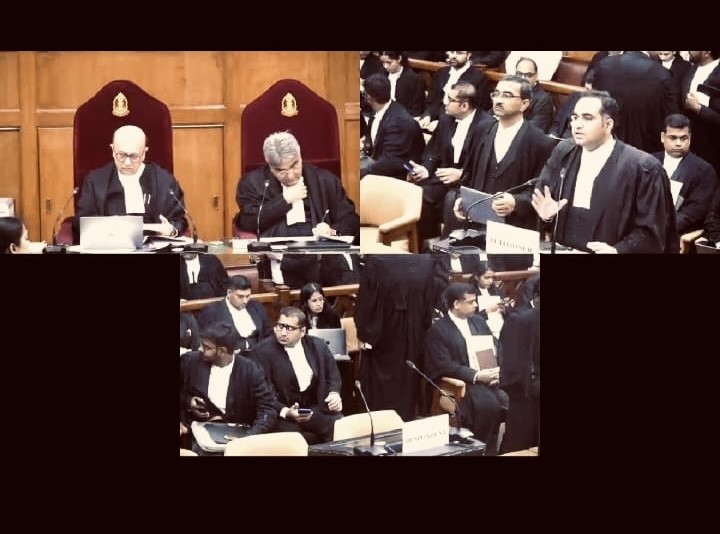
Case Title:
Deep Shikha & Another vs. National Insurance Company Ltd. & Others
Date of Judgment: 13 May 2025
Court: Supreme Court of India
Citation: 2025 INSC 675
⚖️ Overview
In a significant ruling on motor accident compensation, the Supreme Court restored and enhanced the claim of an elderly mother who lost her daughter in a road accident, thereby reinforcing the principle that aged parents may be considered dependents and are entitled to just compensation under the Motor Vehicles Act, 1988.
This case is particularly relevant for understanding how courts treat claims filed by parents and married children of deceased victims.
📝 Factual Background
On 26 January 2008, a woman named Paras Sharma tragically died when a state-run bus struck her two-wheeler due to negligent driving. Her married daughter and aged mother filed a claim petition before the Motor Accidents Claims Tribunal, seeking compensation of ₹54.30 lakhs.
The Tribunal awarded them ₹15.97 lakhs, recognizing both as legal heirs with some dependency.
🧑⚖️ What Happened Before the Supreme Court?
- The High Court reduced the daughter’s compensation to ₹50,000 under the no-fault clause (Section 140) and rejected the mother’s claim entirely, stating she wasn’t a dependent.
- The case was then brought before the Supreme Court, which examined whether the claimants were truly dependents under the law and if the compensation was adequate.
📌 Key Legal Issues
- Can a married daughter claim compensation as a dependent of her deceased mother?
- Does an elderly parent living with the deceased qualify as a dependent?
- Whether the High Court erred in reducing the compensation and rejecting the claim of the mother.
✅ Supreme Court’s Decision
1. On the Married Daughter (Appellant No. 1):
- The Court clarified that while a married daughter qualifies as a legal representative, she must prove financial dependence to claim compensation for loss of dependency.
- As no evidence of dependency was shown, she remained entitled only to ₹50,000 under Section 140 of the Act.
2. On the Aged Mother (Appellant No. 2):
- The mother, aged around 70 and with no source of income, was living with the deceased.
- The Court ruled that the High Court erred in denying her compensation.
- It emphasized that a child’s duty to maintain aged parents is recognized by law, and dependency can be both present and foreseeable.
📊 Recalculated Compensation Using Legal Formulae
The Court recalculated the amount using the principles laid down in:
- National Insurance Co. Ltd. v. Pranay Sethi, (2017) 16 SCC 680
- Sarla Verma v. DTC, (2009) 6 SCC 121
| Head of Compensation | Amount (₹) |
|---|---|
| Monthly Income | ₹24,406 |
| Future Prospects (15%) | ₹3,660 |
| Net Monthly Income (after 50% deduction) | ₹14,033 |
| Multiplier (11 for age 51–55) | ₹18,52,356 |
| Funeral Expenses | ₹15,000 |
| Loss of Estate | ₹15,000 |
| Filial Consortium | ₹40,000 |
| Total Awarded to Mother | ₹19,22,356 |
🔍 Legal Impact and Observations
- This ruling distinguishes between legal heirship and financial dependency, making it clear that both must be evaluated independently.
- Parents, especially in old age, may not need to prove actual income transfer if they were cohabiting with the deceased and without independent support.
- The Court emphasized moral and legal obligations of adult children toward elderly parents.
📘 Conclusion
This decision sets a powerful precedent for claims involving parents of accident victims, affirming their right to compensation under Indian motor vehicle law. It also reiterates that dependency is not just financial but also social and circumstantial.
The judgment strengthens the jurisprudence that compassion and practicality must guide compensation claims, especially for vulnerable family members left behind after a fatal accident.
📌 Key Takeaways for Victims’ Families:
- Always present proof of financial dependency for married children claiming compensation.
- Elderly parents living with the deceased can claim dependency compensation even without direct proof of monetary transfers.
- Loss of consortium and filial loss are now standard compensable heads.
- Use of Pranay Sethi and Sarla Verma guidelines ensures fair calculation of future income and benefits.
👨⚖️ About
Anoop Verma, Advocate
Practicing before the Punjab & Haryana High Court and the Supreme Court of India, specializing in Motor Accident Claims, Criminal Law, and Family Law.
📞 For Legal Help or Consultation:
Visit: www.vlaoffice.com
📧 Email: advanoopverma@gmail.com
📍 Chandigarh