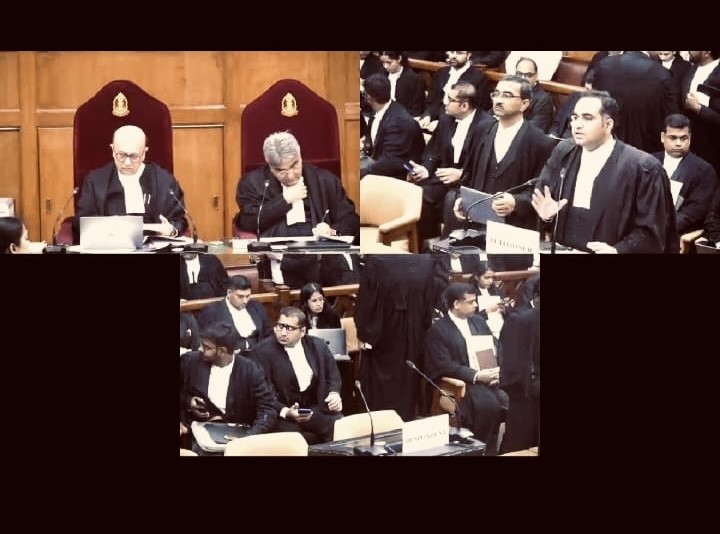
In a significant ruling, the Delhi High Court has reiterated that cheques issued as security under a Memorandum of Understanding (MoU) cannot be treated as cheques issued towards a legally enforceable debt or liability under Section 138 of the Negotiable Instruments Act, 1881.
Justice Neena Bansal Krishna, while deciding the case titled Sri Sai Sapthagiri Sponge Pvt. Ltd. vs. State (GNCT of Delhi) on 27 October 2025, quashed the complaint filed under Section 138 NI Act, observing that a security cheque does not attract criminal liability when no debt or liability exists on the date of its issuance.
The Court observed that when a cheque is issued merely to ensure compliance with future obligations or as part of an MoU for business security, dishonour of such a cheque cannot be termed as a criminal act unless there is an actual subsisting liability. The judgment emphasized that Section 138 NI Act is penal in nature and must be invoked strictly in cases where a legally enforceable debt exists at the time of cheque issuance.
Relying on previous precedents, including Indus Airways Pvt. Ltd. vs. Magnum Aviation Pvt. Ltd. (2014) 12 SCC 539 and Sripati Singh vs. State of Jharkhand (2021 SCC OnLine SC 1002), the Court clarified that a cheque issued as a “security” cannot by itself give rise to criminal prosecution if the underlying agreement makes its encashment conditional upon future events that never materialized.
This judgment is expected to provide relief to individuals and business entities who are facing false prosecutions under Section 138 NI Act based on post-dated or security cheques. It reinforces that criminal law cannot be misused to enforce civil obligations or business defaults that have yet to crystallize.
Background of the Case: Sri Sai Sapthagiri Sponge Pvt. Ltd. vs. State (GNCT of Delhi)
The case arose from a commercial dispute between two companies engaged in the steel and sponge iron business. The petitioner, Sri Sai Sapthagiri Sponge Pvt. Ltd., had entered into a Memorandum of Understanding (MoU) with the complainant company for business cooperation and financial support. As part of the MoU, certain post-dated cheques were issued as security, ensuring adherence to the terms of the agreement.
The complainant alleged that when one of these cheques was presented for encashment, it was dishonoured due to insufficient funds. Consequently, the complainant initiated criminal proceedings under Section 138 of the Negotiable Instruments Act, 1881, before the Metropolitan Magistrate, contending that the dishonoured cheque represented a legally enforceable liability.
However, the petitioner company approached the Delhi High Court under Section 482 Cr.P.C., asserting that the cheque in question was never issued towards a subsisting debt or liability, but was merely a security cheque given under the MoU. The petitioner argued that since the underlying transaction had not matured and no liability had crystallized at the time of cheque issuance, the complaint under Section 138 was not maintainable.
It was further contended that the MoU itself recorded that the cheque was issued only as a collateral safeguard and would become payable only if certain conditions were breached. The petitioner also relied upon a series of judgments of the Supreme Court and various High Courts, asserting that a security cheque cannot be the basis of criminal prosecution unless the complainant proves the existence of a legally enforceable debt on the date of issuance.
In response, the complainant maintained that despite being labeled as a “security cheque,” the instrument had been issued towards a financial arrangement, and its dishonour amounted to a breach of trust and default of payment.
The core issue before the Delhi High Court was whether the dishonour of a security cheque, issued under an MoU without any subsisting debt at the time of issuance, could attract the penal provisions of Section 138 NI Act.
After examining the contents of the MoU, the purpose of the cheque, and the judicial precedents on the subject, the High Court came to the conclusion that the cheque was purely a security instrument and not one issued in discharge of an existing liability. Accordingly, the Court held that no offence under Section 138 NI Act was made out and quashed the criminal proceedings.
This case once again underscores a crucial legal distinction between security cheques and cheques issued towards enforceable debts, a point frequently raised by experienced legal professionals such as Advocate High Court Chandigarh while defending clients in cheque-bounce and business transaction cases.
Legal Arguments and Judgments Referred
During the hearing of Sri Sai Sapthagiri Sponge Pvt. Ltd. vs. State (GNCT of Delhi), both the petitioner and the complainant advanced detailed legal arguments concerning the maintainability of a complaint under Section 138 of the Negotiable Instruments Act, 1881, when the cheque in question was issued purely as a security under a Memorandum of Understanding (MoU).
Arguments on Behalf of the Petitioner
The petitioner company, through counsel, contended that the cheque forming the subject matter of the complaint was never issued in discharge of any existing debt or liability, but was only a security instrument. The cheque was issued to ensure the performance of contractual obligations under the MoU, which contained explicit terms that the payment would arise only upon occurrence of specific contingencies.
It was argued that the primary ingredient of Section 138 NI Act — the existence of a legally enforceable debt on the date of issuance of the cheque — was absent. Hence, its dishonour could not amount to an offence. The petitioner relied upon several authoritative precedents of the Supreme Court and High Courts, asserting that criminal prosecution cannot be used as a tool for enforcing civil or contingent obligations.
The petitioner further emphasized that the MoU itself explicitly labeled the cheque as a “security cheque”, and there was no acknowledgment of any existing debt. Thus, the complaint was an abuse of the process of law, and the continuation of proceedings would amount to harassment.
Arguments on Behalf of the Complainant
The complainant, however, maintained that the cheque was given in furtherance of financial arrangements between the parties and was part of a legally binding transaction. It was contended that even if the cheque was termed as “security,” its dishonour amounted to a breach of faith and the petitioner could not escape criminal liability under Section 138.
The complainant argued that the terminology “security cheque” is not decisive — what matters is whether a liability existed when the cheque was presented for payment. Since the cheque was eventually deposited after the petitioner’s failure to perform its commitments under the MoU, it represented a crystallized liability at that stage.
Judgments Referred and Relied Upon
Both parties referred to a number of precedents to substantiate their respective stands. The High Court, while deciding the case, placed reliance on the following key judgments:
- Indus Airways Pvt. Ltd. vs. Magnum Aviation Pvt. Ltd. & Anr. (2014) 12 SCC 539
The Supreme Court held that if a cheque is issued as an advance payment or for security, and no debt or liability exists on the date of issuance, the dishonour of such cheque does not constitute an offence under Section 138 NI Act. - Sripati Singh vs. State of Jharkhand & Anr. (2021 SCC OnLine SC 1002)
The Court clarified that although a security cheque may later mature into a legally enforceable debt, its nature and purpose must be ascertained from the underlying transaction. If no debt existed on the date of issuance, prosecution under Section 138 cannot be sustained. - Shanku Concretes Pvt. Ltd. vs. State of Gujarat (2023 SCC OnLine Guj 1705)
The Gujarat High Court held that mere breach of a commercial understanding or MoU cannot be criminalized under Section 138 NI Act, especially when the cheque was issued as a performance guarantee or security. - M/s Balaji Seafoods Exports (India) Ltd. vs. Mac Industries Ltd. (1999) 1 MWN (Cri) DCC 184 (Mad)
The Madras High Court observed that Section 138 is penal in nature and cannot be invoked unless a specific, legally enforceable liability exists.
The Delhi High Court, after analyzing the contractual terms of the MoU and the ratio of these judgments, concluded that the cheque was a mere security instrument, and since no liability existed on the date of issuance, the prosecution was legally unsustainable.
The ruling reinforces the settled legal principle often invoked by experienced practitioners such as Advocate High Court Chandigarh — that the dishonour of a security cheque does not automatically lead to criminal prosecution, unless the complainant successfully establishes an enforceable debt or liability at the time of presentation.
Court’s Observations and Final Decision
While examining the facts, the Delhi High Court undertook a detailed analysis of the Memorandum of Understanding (MoU) and the purpose for which the cheque in question had been issued. Justice Neena Bansal Krishna observed that the MoU clearly reflected that the cheque was intended to act as a security measure, ensuring the petitioner’s compliance with certain obligations, and not as payment towards any pre-existing liability or debt.
The Court noted that for an offence under Section 138 of the Negotiable Instruments Act, 1881, the following essential ingredients must be satisfied:
- The cheque must have been issued in discharge of a legally enforceable debt or liability;
- The cheque must be presented within its validity period;
- The cheque must be returned unpaid by the bank due to insufficiency of funds or similar reasons; and
- The drawer must fail to make payment within 15 days after receiving the statutory notice of dishonour.
In the present case, the first condition — the existence of a legally enforceable debt or liability — was found to be absent. The Court held that when a cheque is issued only as a security, it cannot be said to represent an existing debt at the time of issuance. The Court relied heavily on the ratio of the Supreme Court in Indus Airways Pvt. Ltd. vs. Magnum Aviation Pvt. Ltd. (2014) 12 SCC 539, reiterating that the penal consequences under Section 138 cannot be invoked where the debt is contingent or not yet crystallized.
Justice Bansal Krishna emphasized that criminal law cannot be invoked as a tool for arm-twisting or for enforcing contractual arrangements, especially in cases arising out of MoUs or commercial collaborations. The Negotiable Instruments Act is intended to enhance the credibility of cheques as a mode of payment, not to penalize business relationships that fail for commercial reasons.
The Court further observed that allowing prosecution in such cases would blur the distinction between civil disputes and criminal liability, resulting in misuse of criminal process for debt recovery. Hence, continuing the complaint under Section 138 NI Act in the absence of a subsisting liability would amount to abuse of the process of law.
Accordingly, the Delhi High Court quashed the complaint proceedings pending before the Metropolitan Magistrate and reaffirmed that security cheques issued under commercial MoUs do not automatically give rise to criminal prosecution under Section 138 NI Act.
Conclusion
This ruling once again highlights the judicial trend of protecting individuals and companies from misuse of Section 138 proceedings, particularly when security cheques are issued in good faith for future performance of agreements.
About Advocate Anoop Verma
Advocate Anoop Verma is a distinguished Advocate at the Punjab and Haryana High Court, Chandigarh, and also appears before the Supreme Court of India. With years of dedicated experience in criminal law, bail matters, quashing petitions, and cases under Section 138 of the Negotiable Instruments Act, he is known for his practical approach and sharp legal strategy.
He has represented clients in numerous complex criminal and financial cases across Chandigarh, Haryana, Punjab, and Delhi, earning a reputation for professionalism, clarity, and result-driven advocacy.
For legal consultation or representation before the High Court or Supreme Court, you may contact:
📞 Phone: +91-9463742964
✉️ Email: advanoopverma@gmail.com
🌐 Website: www.vlaoffice.com
📍 Office: Punjab & Haryana High Court, Chandigarh
If you’re looking for a reliable and result-oriented Advocate High Court Chandigarh, Advocate Anoop Verma provides effective legal assistance backed by thorough preparation, client trust, and a deep understanding of Indian criminal jurisprudence.